

As we move through the early stages of a new year, we take a moment to reflect on the major developments that shaped the Irish and Northern Irish energy sectors in 2025.
Where we stand on 2030 targets
Ireland’s 2025 Climate Action Plan (CAP) reaffirmed its commitment to sourcing up to 80% of electricity from renewables by 2030, alongside a 51% reduction in greenhouse gas emissions compared with 2018 levels. However, in January 2026 the Minister for Climate indicated that Ireland is likely to achieve only about half of that emissions‑reduction target.
Northern Ireland maintained a similar level of ambition, at least 80% renewable electricity consumption and a 48% reduction in emissions relative to 1990.
Onshore wind and solar: strong growth with gaps
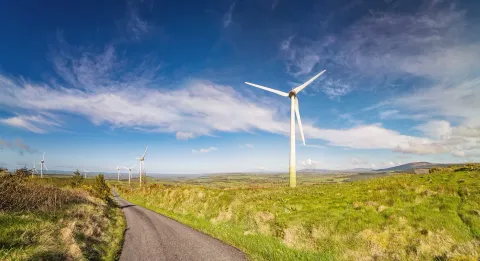
The CAP sets out ambitions for 9GW of onshore wind and 8GW of solar by 2030, supported primarily through the Renewable Electricity Support Scheme (RESS). In 2025, the RESS 5 auction procured 1,072MW of new capacity, a rebound from the low point of RESS 3, but still short of what’s required for the 2030 pathway, particularly for onshore wind.
Ongoing challenges around price caps and indexation continue to limit some developers’ ability to participate. As the longstop date for RESS 5 projects is December 2030, this auction, and possibly some projects awarded under RESS 6, may be the last that can contribute towards the 2030 targets.
On a positive note, solar continued its impressive rise. Of the RESS 5 awards, 853MW went to solar projects and, by November 2025, Ireland’s installed solar capacity exceeded 2GW – an increase of more than 160% in just two years. With more than 21GW of solar and solar‑hybrid projects either operating or in the pipeline, Ireland has the potential to reach its 8GW solar goal.
Offshore wind: rebuilding momentum
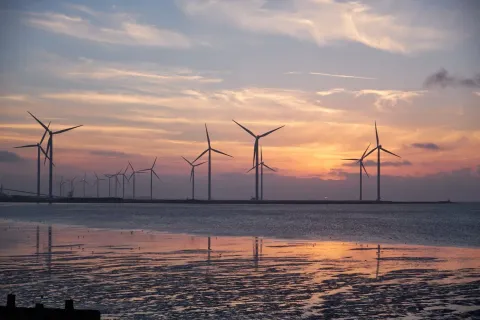
Offshore wind also saw renewed movement during 2025. Ireland published the results of the second Offshore RESS auction, Tonn Nua, where a joint venture between ESB and Ørsted secured rights to develop a 900MW project off the south coast. This result helped restore confidence after earlier setbacks, including confirmation that the Sceirde Rocks Wind Farm would not proceed.
Delivery of ORESS 2.1 will play an important role in shaping the next auction, ORESS 2.2, which aims to procure up to 1.5GW for the Lí Ban site.
Northern Ireland’s policy steps forward
In 2025 Northern Ireland took a major step forward, with the Department for the Economy (DfE) publishing the final design for the new Renewable Electricity Price Guarantee, which will replace the long‑closed Northern Ireland Renewables Obligation scheme. The first REPG auction is expected in early 2027 and aims to procure between 750 and 1,250GWh of renewable electricity annually. To meet the 80% by 2030 target, the DfE expects that another auction would be needed with a procurement volume of 3,250-3,750GWh/year,
As a temporary measure, Northern Ireland has committed to providing full compensation for all curtailment and constraint‑related dispatch‑down events. This is a welcome step for generators, following dispatch‑down levels reaching 25.5% in 2024.
Grid investment and interconnection
Ireland published its Sectoral Capital Plan for 2026-2030, including up to €5.64 billion in National Development Plan funding and €3.5 billion in planned EirGrid and ESB investments. Alongside this came the Accelerating Infrastructure Action Plan, which aims to speed up the delivery of key projects across energy, transport and water.
Interconnection also strengthened with the launch of the Greenlink Interconnector between Wexford and Wales. This added 500MW to Single Electricity Market’s (SEM) interconnection capacity, making it 9% of total installed capacity across the SEM.
The CRU published a new connection policy for data centres requiring them to provide onsite or nearby dispatchable generation or storage matching their import capacity. And toward the end of the year, Government approved drafting the Private Wires Bill, which will open the door for private investment in grid infrastructure, an important step in reducing dispatch‑down and enabling more renewable generation.
Flexibility, storage and system services
The Future Arrangements of System Services (FASS) is the new overarching framework to transition how system services are procured in Ireland and Northern Ireland. FASS is due to go-live with the Day Ahead System Services Auction (DASSA) in May 2027
The planned transition to the FASS workstream - coupled with continued reducing of de-rating factors in the Capacity Remuneration Mechanism (CRM) reducing the value of a CRM contract for battery energy storage system (BESS) assets - will likely require BESS assets to participate in other markets in order to be commercially viable.
In October 2025, the DASSA Parameters and Scalars Recommendations were submitted to regulators, and approval was granted for a top‑up mechanism that will enable additional support when service procurement falls short.
EirGrid also advanced its work on long‑duration energy storage, releasing a consultation on a procurement mechanism to secure between 201MW and 500MW of technology‑neutral storage capable of operating for at least four continuous hours.
Where does that leave us?
Even though our latest modelling for the SEM suggests that, based on existing policies and current project delivery rates, the 2030 targets will not be met, 2025 was undeniably a year of significant progress.
Ireland saw continued growth in solar, renewed certainty in offshore wind and important steps forward in flexibility and storage. Northern Ireland demonstrated a strengthening policy framework, continued growth in its low‑carbon economy and clear movement toward the introduction of a new renewable support scheme.
Together, these developments paint a picture of two energy systems that are evolving quickly, even if not yet quickly enough.
Did you like this blog? Get insights just like it delivered straight to your inbox. Sign up here.
Interested in finding out more?
Sign up for our Introduction to Irish Electricity Markets training course on 24-25 February: