Nearly three quarters of Great Britain’s household energy market will sit with three suppliers after the Competition and Markets Authority cleared E.ON’s takeover of OVO. The merger will leave Octopus Energy, British Gas and E.ON with 74% of the domestic energy market, with some regions of Great Britain (GB) seeing over 79% of customers served by these suppliers.
The data from Cornwall Insight’s Domestic Energy Market Share Survey, puts the enlarged E.ON as the second biggest domestic supplier in GB, with 25% of household electricity and gas accounts. This is behind Octopus Energy at 26%, and ahead of British Gas at 23%. Following the merger, the top five suppliers, which includes EDF and Scottish Power (SP) on top of the largest three suppliers, will control 90% of the market.
Since 2020, high wholesale prices have pushed many smaller suppliers out of the market, and those same high prices, alongside the Price Cap, have kept switching well below pre-2020 levels. With fewer households shopping around, the market has become a far harder place for new entrants to thrive.
Domestic market share can be measured in different ways. Cornwall Insight measures market share by the total number of electricity and gas accounts a supplier has on live supply, this means dual fuel consumers who receive both gas and electricity are counted as two accounts. By contrast, customer accounts count a dual fuel customer only once, regardless of how many fuels are supplied. This is why supplier rankings may differ depending on the metric being used.
Energy accounts are generally considered a more meaningful measure of supplier scale within the domestic energy market because they better reflect the number of supply points being served and the overall size of a supplier’s retail portfolio.
Figure 1: Domestic Energy Market Share following E.ON’s acquisition of OVO Energy
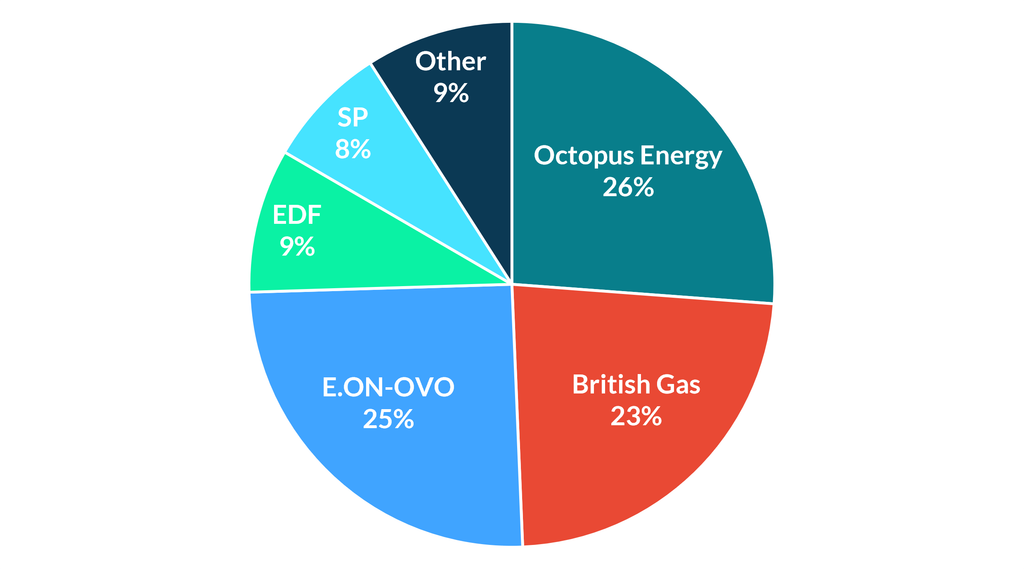
Source: Cornwall Insight Domestic Market Share Survey
Note: figures are rounded to the nearest whole number
Tom Goswell, Energy Supply Lead at Cornwall Insight:
“The big six have become the big three, and there have been questions raised over how this will impact household choice and the health of the market. Larger suppliers do bring with them a degree of stability, and after around 30 firms dropped out of the market, leaving customers wondering who would be sending their next bill, stability is not something to dismiss lightly. They also have the scale to invest in tariffs smaller companies often struggle to offer, such as deals built around electric cars or cheaper power at off-peak times.
“The concern with fewer suppliers is that the pressure to compete eases off, taking with it some of the incentive to keep prices low and offer something different. The big suppliers have the resources to give people real choice, and the test over the next few years will be whether households who shop around find a genuine range of deals waiting for them rather than three versions of the same thing.”