

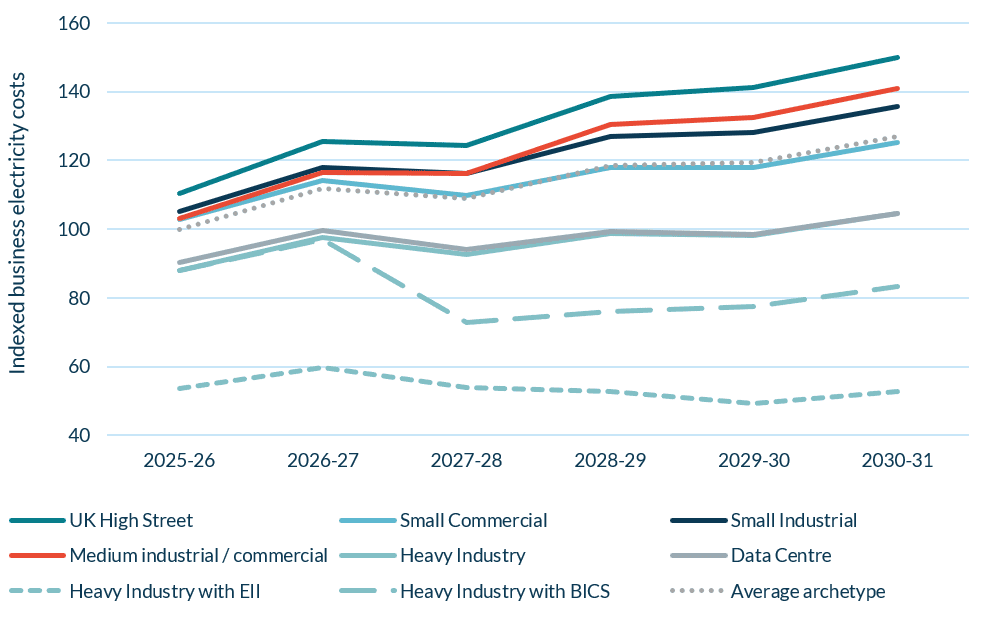
Every type of business, from high street shops to data centres, faces higher electricity bills for the rest of the decade, with costs set to rise by more 25% on average from 2025 to 2030. The figures come from Cornwall Insight’s new Business Energy Price Tool1, a business equivalent to its household price cap forecasts.
Business electricity bills rose by around 12% on average this year and are not expected to drop back to last year’s levels before 2031. For those more exposed to current high wholesale prices, that increase will be much greater.
The size of the rise varies widely. High street shops are some of the hardest hit, with bills forecast to rise 36%, more than twice the 16% forecast for data centres. However, for a representative data centre that smaller rise still means finding an extra £14 million a year. Data centres are also among the businesses adding the most demand for electricity, so their costs will grow further as they expand.
Most of the increase comes from network charges, which are expected to make up over 40% of average pre-VAT bills by 2030, up from 25% today. Smaller businesses pay more for every unit of electricity they use, as they sit at the far end of the local network and their fixed daily charges are spread across much less electricity.
Sustained electricity cost increases will deepen the challenges already being faced by businesses across the economy, from hospitality to steel. Targeted government support for energy-intensive industries, such as the British Industry Supercharger and the British Industrial Competitiveness Scheme, will ease costs for some of the largest users or those in specific sectors, cutting eligible firms’ bills by around 40% and 20% respectively. However, more than nine in ten – 2.7 million businesses – do not receive government support to lower these costs.
Figure 1: Forecast electricity costs by archetypal business site, Cornwall Insight’s Business Energy Price Tool
| Business type | 2025-26 (£/yr) | 2030-31 (£/yr) | Increase (£/yr) | % change |
| UK High Street | £4,300 | £5,900 | £1,600 | 36% |
| Small Commercial | £57,600 | £70,100 | £12,500 | 22% |
| Small Industrial | £219,000 | £283,000 | £64,000 | 29% |
| Medium Industrial / Commercial | £632,000 | £862,000 | £230,000 | 36% |
| Heavy Industry | £12,050,000 | £14,310,000 | £2,260,000 | 19% |
| Data Centre | £89,470,000 | £103,550,000 | £14,090,000 | 16% |
| Average business | 27% |
Source: Cornwall Insight’s Business Energy Price Tool
Figure 2: Indexed ‘all-in’ electricity cost, nominal
Source: Cornwall Insight Business Energy Price Tool
Jacob Briggs, Energy Users Lead, Cornwall Insight:
“Energy bills for British businesses are among the highest in the developed world, and every business we’ve modelled will be paying significantly more by the end of the decade than they do today.
“Smaller firms carry more of the weight of network and policy charges for every unit of electricity they use. For many high street businesses operating on tight margins, a 36% increase is far more than a minor cost pressure and can influence investment decisions, hiring plans and, in some cases, whether a business stays open.
“Larger users have their own challenge, as finding more than £2 million extra a year for a heavy industrial site, or £14 million for a data centre, is a serious ask for businesses already competing internationally.
“Support for energy-intensive industries has an important role, but there is a risk that the majority of businesses are left paying higher bills while the few receiving support are the only ones who can expect any relief. The Budget made cheaper, cleaner power the Government’s main energy priority, and if that is going to support growth, businesses of every size need to feel it on their bills. How policy and network costs are recovered will be a key part of that,”
Reference:
- The price tool looks at 6 different archetypes: High Street, Small Commercial, Small Industrial, Medium Industrial / Commercial, Heavy Industry, Data Centres.
- Cutting business energy costs: A blueprint to boost growth – CBI, Energy UK and Cornwall Insight
Business Energy Price Tool
Answer four questions for a free, indicative comparison of how energy prices are changing for a business like yours.