
Households are set to save around £44 on a typical dual-fuel energy bill after the government announced a 5% VAT cut on electricity today, though this saving looks likely to be wiped out by rising wholesale costs. Under the newly adjusted definition of a typical household (Typical Domestic Consumption Values)1, the October price cap is currently predicted to be £1,700 per year. Under the previous definition2, the cap would be set at £1,906.
While the government’s VAT removal will ease electricity costs, unfortunately overall bills will not be falling, and households are still looking at an approximate 2% rise on the current price cap3, largely driven by increased unrest in the Middle East pushing wholesale costs up.
While bills will not be falling, an added benefit of the VAT cut is that it will slightly reduce the cost difference between electricity and gas, and that gap needs to keep closing if households are going to be encouraged to switch to electric heating and vehicles. Without that shift, the wider transition to a low carbon energy system will be more challenging for customers.
The timing of the VAT cut is notable given yesterday’s reshuffle which saw Miatta Fahnbulleh take over as Secretary of State for Energy Security and Net Zero. We await to see if the government goes further on bills at the Budget, with policy levies potentially shifting into general taxation and block tariffs still under discussion.
Figure 1: Cornwall Insight’s October – December Default Tariff Cap forecast (dual fuel, direct debit customer)
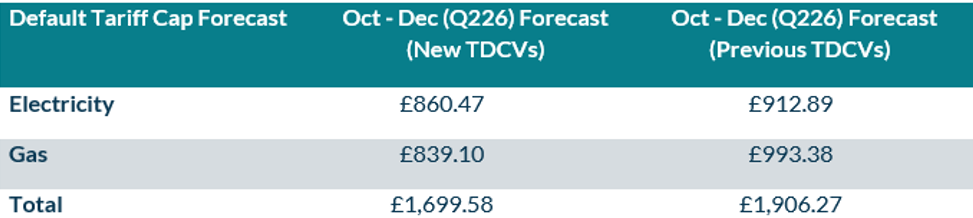
Source: Cornwall Insight’s Default Tariff Cap Forecast Service
Note:
- The new TDCVs came in on 1st July
- All figures are national average unless otherwise stated. All intermediate and final calculations are rounded to two decimal places. Totals may not add due to rounding.
Figure 2: Default Tariff Cap forecast, Per Unit Costs and Standing Charge (dual fuel, direct debit customer). These do not include the variances above.

Source: Cornwall Insight’s Default Tariff Cap Forecast Service
Dr Craig Lowrey, Principal Consultant at Cornwall Insight:
“The VAT cut will be particularly welcome as we move into winter, especially for anyone whose usage is already high, whether that’s due to a big family home, a house with electric heating, or someone with high electricity demand given a medical or health need.
“The real question now is what the new Secretary of State for Energy and Net Zero does with the Budget, given that the government has stated that the VAT reduction is only confirmed until the end of the current financial year. There’s talk of moving some levies into general taxation and even bringing in block tariffs, which would be a much bigger shift than a VAT cut. She has only just taken on the role, so the whole energy industry be watching closely for signals on where energy policy may be heading.”
Reference:
- Ofgem’s central case Typical Domestic Consumption Values (TDCVs) which came in on 1st July are 2,500 kWh per annum for electricity and 9,500 kWh per annum for gas. The change reflects the fact that typical energy consumption has fallen in recent years.
- Ofgem’s previous central case Typical Domestic Consumption Values (TDCVs) were set at 2,700 kWh per annum for electricity and 11,500 kWh per annum for gas.
- The price cap for Q3 (July – September) has been set by Ofgem at £1,862 under current TDCVs and £1,663 under the TDCVs coming in from 1st July.
Price Cap Predictor
Our industry-leading Default Tariff Cap forecasts remain consistently in line with the outturn levels – providing a high degree of accuracy and confidence to our clients. They are used by industry and mainstream media, as well as the government in support of policy measures.