New forecasts reveal that households in North Scotland, and North Wales and Mersey are set to pay around £100 more annually for electricity in 2025-26 compared to those in London. With the cost of distributing electricity found to be the primary reason.
The data from Cornwall Insight’s ‘Third-Party Charges Cost Forecast’, which analyses regional third-party charges (TPCs) for each financial year, shows customers in North Wales and Mersey will be paying £120 more than those in London in 2025-26, with TPC’s reaching £466 a year for those in North Wales compared to £346 a year for those in London. Households in North Scotland will be paying £96 more than the capital.
While the debate over zonal pricing is heating up across the country, with some calling the plans a ‘postcode lottery’. The new data shows that energy bills already vary significantly depending on where people live.
TPCs include all costs outside the price of the fuel itself – the wholesale price – and typically make up around two-thirds of a household’s energy bill. They are broadly split into network charges like distribution and transmission costs, and policy costs such as funding for government initiatives like renewable energy and household support. The disparity in costs is largely due to the expense of distributing energy to less densely populated and more challenging terrains. Historically, wholesale costs have driven the largest part of a domestic gas and electricity bill. However, with the shift towards a renewables-led system and the move from gas to electricity, network and balancing costs will increasingly dominate household energy bills.
The data will prompt calls for the government and other stakeholders to account for regional disparities when reviewing any policies to support consumers with their energy bills, including reform of TPCs, or the introduction of social tariffs.
Households in North Scotland and North Wales and Mersey currently pay £72 and £86 a year more than London respectively.
While policy costs are relatively uniform across the country, with only minor differences between regions, network charges, particularly distribution costs vary greatly from region to region. In Great Britian there are 14 electricity distributors also known as Distribution Network Operators (DNOs), each DNO faces different costs. In regions like North Scotland, and North Wales and Mersey, network operators face higher costs due to factors such as challenging terrain, greater distances between populations, and colder weather conditions, making electricity distribution more complex and grid maintenance more expensive than in densely populated areas like London.
The DNOs recover the costs from generators and suppliers, and these are ultimately passed on to households and businesses in their electric bills raising energy bills in these regions. The disparity would be even higher in Scotland if not for the subsidy paid to North Scotland’s DNO, Scottish Hydro Electric Power Distribution, through the Assistance for Areas with High Electricity Distribution Costs (AAHEDC) scheme.
The government has several options available to support households struggling with bills, including introducing social tariffs, and reforming how TPCs are collected. A newly designed social tariff must account for existing regional price differences, to avoid certain regions being out of pocket.
Similarly, any reform of TPCs, such as the current review for a mandatory zero standing charge tariff, should take regional variations into consideration, to prevent higher unit rate charges in higher-cost network areas, leaving those households relatively worse off.
Figure 1: Domestic Third Party Charges Cost Forecasts Financial Year 2025-2026 in each Distribution Network Operator Region
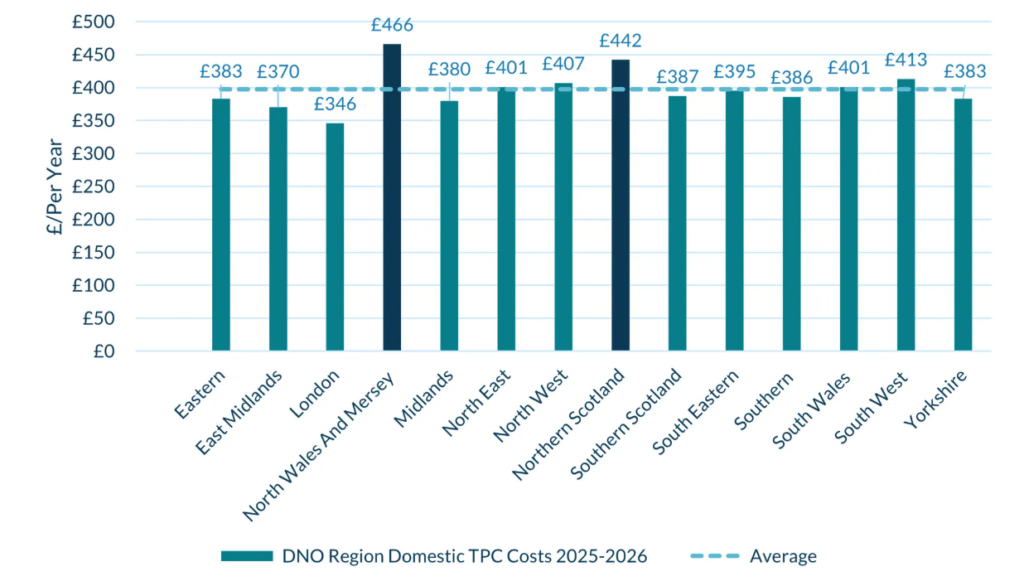
Source: Cornwall Insight – Third-Party Charges Cost Forecast
Lee Drummee, Senior Analyst at Cornwall Insight, said:
“The difference in electricity costs between different parts of Great Britain continues to be a challenge, particularly for rural and remote areas. While the debate about the potential introduction of zonal wholesale pricing continues, it’s important to recognise that regional pricing is already baked into the system. Some costs are spread nationally, but others, like network charges, already reflect where you live. In that sense, energy bills are already a postcode lottery. Zonal pricing is just one part of the picture, the reality is that regional differences are already having a big impact.
“With energy affordability under increasing scrutiny, there is a need for a broader conversation on how we can support households across different regions lower their energy bills, and indeed how we can support all vulnerable people regardless of location.
“While network costs are a relatively small part of the bill, they are set to become more important as we transition towards a net zero system. The government, and other stakeholders, should consider the anticipated cost variations when making decisions on any policies designed to reduce consumer bills, otherwise regional disparities risk getting worse not better.”
Third Party Charges Forecast
Robust, independent five-year outlook of third-party charges and assessment of scale and trajectory.