

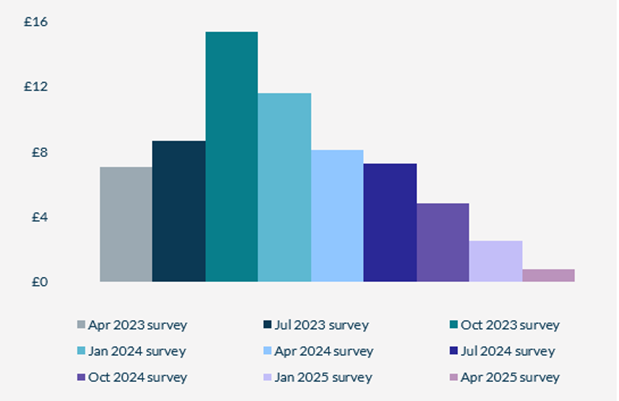
The future of Renewable Energy Guarantees of Origin1 (REGOs) is facing growing uncertainty as prices collapse and confidence in the system wanes. According to Cornwall Insight’s latest Green Certificates Survey2, prices for REGOs – certificates bought by suppliers to demonstrate electricity was generated from renewable sources – have dropped by 70% in just three months, falling for the sixth consecutive quarter.
The dramatic drop in price, from an average of £2.56 in January to just £0.77 in April for the 2024–25 Fuel Mix Disclosure period, is being driven by a surge in renewable energy supply, and a shift among corporates toward alternative decarbonisation methods such as power purchase agreements (PPAs).
REGOs are issued by Ofgem to renewable electricity generators for each megawatt hour (MWh) of renewable electricity they produce. Suppliers buy these certificates to demonstrate that the electricity they provide to customers is backed by renewable generation. But, because all electricity mixes once it enters the grid, REGOs have drawn criticism from some quarters as a form of ‘greenwashing’.
The sharp drop in prices follows a period of historically high REGO prices in 2023, which reached average highs of over £15 per certificate. This was driven by limited new capacity in the Government’s renewables auction – Contract for Difference (CfD) – allocation rounds, delays to existing renewable projects, and additional demand triggered by suppliers no longer being able to use EU Guarantees of Origin. Together, these factors created uncertainty around future REGO supply, pushing prices to record highs.
Since then, market sentiment has shifted: more renewable projects have come online, confidence in future supply has grown, and demand for REGOs among corporates has softened.
While prices have fallen to levels last seen in 2021, the bigger question is what comes next. The UK Government held a call for evidence on REGOs in 2021 and published a summary of responses in 2023 but has yet to set out a clear path for reform. A new workstream on greenwashing and consumer transparency is expected to begin later this year, as part of the ongoing Review of Electricity Market Arrangements (REMA).
Additionally, some major suppliers in the UK are questioning the effectiveness of REGOs, with OVO announcing in 2023 that it would stop purchasing them entirely. Whether other suppliers will follow suit, and what reforms may ultimately emerge, could reshape the role of REGOs in the UK’s decarbonisation journey.
There are some potential changes on an international scale which could dampen the use of REGOs further, for example the global group for greenhouse gas emissions – Greenhouse Gas Protocol – is launching a review of how global organisations report electricity-related emissions, including the use of renewable certificates such as REGOs. Asking whether they truly lead to additional renewable energy generation, and could potentially actually slowing down the overall reduction of global emission.
Cornwall Insight’s Green Certificates Survey gathers insight from sellers, buyers, brokers, and generators to track market sentiment and trends in the REGO market.
Figure 1: Average REGO prices (£/MWh) for Fuel Mix Disclosure period 2024-25
Source: Cornwall Insight
Dr Matthew Chadwick, Lead Research Analyst, at Cornwall Insight:
“We’re not just seeing prices tumble, we’re seeing confidence in the REGO system itself start to crack. As renewable supply surges and buyers seek alternatives, these certificates are losing their position as the default way to demonstrate green credentials. What was once a relatively niche market is now under national scrutiny, and its future hangs in the balance.
“As prices continue to fall and questions mount, there’s growing unease about whether REGOs still serve their purpose. Are they genuinely helping to drive decarbonisation, or simply offering a convenient green label? Without meaningful reform – or potentially a new approach altogether – there’s a real risk that trust in the system will erode further.”
Reference:
1. The REGO scheme was established in 2003 following the 2001 EU Renewable Energy Directive with a purpose, as expressed by the directive, to track and monitor the green characteristic of electricity as it is transferred across the industry and to the customer. One REGO is issued per MWh of electricity generated. It was not originally created with the intention for it to be used for corporate emission reporting.
2. 23 individuals from 20 distinct organisations participated: 22 participants traded in REGOs, 15 identified their role primarily as sellers; 4 as buyers; and 2 as brokers/traders, and one as a REGO producer with an oversight of trading.