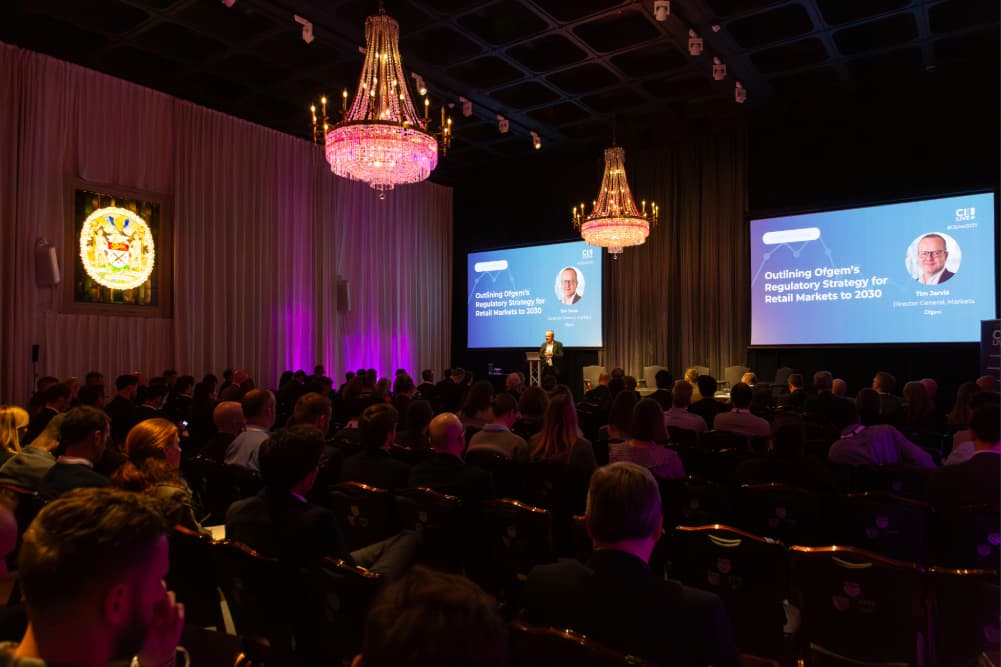

As part of our celebration of 1,000 issues of Energy Spectrum, we asked a group of leading industry voices five short questions on the shifts that have defined the market, the signals they’re watching and what Energy Spectrum means to them.
Christopher Dalley, Director of Business and Wholesale, EDF Energy
What’s been the single biggest shift in the energy market since you began your career?
The most significant shift in the energy market over my career has been the structural decline of coal generation alongside the rapid scaling of renewables. What’s fundamentally changed is not just the generation mix, but how the system operates; we’ve moved from a model built on dispatchable power to one that depends on managing intermittency and actively connecting generation with demand. That places far greater emphasis on optimisation, flexibility, trading and interconnection, areas where integrated players with capabilities across generation, demand and optimisation can play a critical role in keeping the system balanced and efficient.
What’s one trend in today’s energy landscape that is still underappreciated?
An underappreciated trend in today’s energy landscape is the growing price cannibalisation of solar and wind, and the associated rise in shaping and capture price risk. As penetration increases, value is shifting away from simply generating power towards how effectively that power is optimised, shaped and traded. That’s driving a structural change in the market, where sophisticated route to market strategies, flexibility and commercial optimisation are becoming the key sources of value.
What’s one market signal you’re watching most closely right now?
The market signal I’m watching most closely is the BSUoS cost outturn, particularly against a backdrop of sustained gas price volatility. It’s a useful proxy for system stress and inefficiency, and highlights the growing cost of balancing a more complex energy system.
What will define success for the UK energy sector over the next decade?
BSUoS is also one of the more unpredictable supplier charges on consumer bills, so monitoring how it evolves and whether NESO increases rates is vital for keeping customers informed against the current affordability challenge. For us, it reinforces the importance of bringing forward more flexible capacity and smarter optimisation solutions to reduce overall system costs over time.
What will define success for the UK energy sector
Success for the UK energy sector over the next decade will be defined by how effectively we deliver Clean Power 2030 while maintaining affordability, system resilience and stability for businesses. That requires more than just building renewable capacity, but an integrated system where generation, storage, flexibility, interconnection and demand side response are optimised together.
For businesses, success will increasingly be defined by energy stability and predictability rather than the absence of volatility. Clear policy direction, investable market signals and access to flexible products including long-term contracting and smarter use of data can give businesses the confidence to invest and grow even as the system continues to transition.
In three words, what do Energy Spectrum and Cornwall Insight mean to you?
Insightful, authoritative, trusted.
Adam Scorer, Chief Executive, NEA
What’s been the single biggest shift in the energy market since you began your career?
Nothing new here. It’s the price cap. Not only because it created a different set of dynamics and interventions (regulatory and political) for the market, but because of what it was trying to correct. Persistent overpaying, distrust, low engagement, poor supplier practice. It did not resolve those issues, but it set a shared framework and set of data, through which they could be addressed.
What’s one trend in today’s energy landscape that is still underappreciated?
Household energy debt is one area where the full consequences are underappreciated. For National Energy Action clients, we see for certain how debt crushes our clients financially and in terms of engagement and trust with suppliers. But less appreciated is how it shuts down a decarbonisation pathway for our clients. It makes it difficult to disconnect from gas, harder to switch to flexible tariffs, more challenging to engage with schemes and so on. A consumer-led, fair, low carbon transition just does not happen in those circumstances.
What’s one market signal you’re watching most closely right now?
I’m sticking with debt levels. Not just the quantum, but the composition. With arrears at around 75% of the total debt mountain and rising, we are watching effective and mutually beneficial consumer engagement with the most vulnerable people disappear into the distance. How bad does bad have to be, before we do more than watch?
What will define success for the UK energy sector over the next decade?
Not one single thing. Shaping the retail market to allow accelerated access and material benefits for fuel poor households from the Warm Homes plan related schemes and ambitions must be in the top three. That means access to fair time of use tariffs, better deals on solar and storage, protection for folk left on gas, focused advice and support for those with little market power or consumer confidence and a lot more.
In three words, what do Energy Spectrum and Cornwall Insight mean to you?
Definitive. Independent. Trusted.
Dhara Vyas, Chief Executive, Energy UK
What’s been the single biggest shift in the energy market since you began your career?
The end of coal! When I started working in energy back in 2009 coal was responsible for nearly a third of the UKs electricity generation. It’s a massive achievement – coal has the highest carbon intensity of all fossil fuels, contributing disproportionately to greenhouse gas emissions and continues to be a leading driver of global climate change. It’s also really scary when it comes to air and health pollution, burning it releases toxic byproducts into the air that are linked to asthma, heart disease, COPD and other illnesses . I’m super proud that the UK has led the way on showing that it can be safely phased out, with a fair approach to the transition for workers too.
What’s one trend in today’s energy landscape that is still underappreciated?
Flexibility – it is critical and we need to make it easier for market participants and for customers. Embedding flexibility can reduce national energy system costs by £4.6 Billion by 2030. Modernising the capacity market and expanding consumer led flexibility are both long overdue.
What’s one market signal you’re watching most closely right now?
Investor sentiment – I am so acutely aware of the impact that political uncertainty has on investor confidence. War in Iran, an impending cost of living crisis and the political fallout following the elections earlier this month (across the English local authorities, the Senedd in Wales and Holyrood in Scotland) will all have an impact on what the Government might choose to do next. We also continue to be in a race for global capital when it comes to the energy transition – from supply chain to customer service, grid, turbines and smart products the UK has the potential to continue to lead the way – this all relied on private sector investment. I want our country to continue to be ambitious.
What will define success for the UK energy sector over the next decade?
Two things – the first is getting it right on affordability, and the second is helping people across the country to understand the why we need an energy transition and what it means to them. The energy industry cannot deliver on either of these things alone, as we have done over a decade of delivery, we know we need to keep working closely with politicians from all political parties, with organisations from across civil society, and engaging with people and communities across the country is going to be crucial.
In three words, what do Energy Spectrum and Cornwall Insight mean to you?
Three things (but not three words) – 1) insightful analysis, 2) supporting people to learn and 3) expertise and depth!
Andy Peyman, Power Markets Senior Manager, Island GP
What’s been the single biggest shift in the energy market since you began your career?
The shift from a system dominated by fossil fuel dispatchable generation to one increasingly dominated by intermittent renewables.
What’s one trend in today’s energy landscape that is still underappreciated?
Flexible demand – it’s finally coming.
What’s one market signal you’re watching most closely right now?
The emergence or disappearance of negative prices.
What will define success for the UK energy sector over the next decade?
Successful electrification of demand.
In three words, what do Energy Spectrum and/or Cornwall Insight mean to you?
Information clearly communicated.
Gareth Miller, Chair, Non-Executive Director
What’s been the single biggest shift in the energy market since you began your career?
I began my career in energy in 2005. Since then the biggest shift has been in the power sector, with the incredible surge in renewable capacity. But despite 21 long years later we are still only just getting round to resolving network and supply-side constraints that I recall being the focus of conference delegate’s ire back two decades ago. That is a missed opportunity if ever there was one.
What’s one trend in today’s energy landscape that is still underappreciated?
We are underappreciating the complexity, conditionality and cost of net zero. We focus on success in the power sector, but that’s low hanging fruit. Decarbonising across the broader economy will require much greater levels of investment, change and adaptation than is commonly understood. The failure of policymakers to prime people for this remains the greatest threat to it happening at all.
What’s one market signal you’re watching most closely right now?
The outcome of the next UK general election. Much can change, but if the Reform party and the Conservative Party are to be taken at their word, we may see an epoch shift in energy policy, as unwavering cross-party commitment to the Climate Change Act has already unravelled.
What will define success for the UK energy sector over the next decade?
Coming up with a durable, sustainable and fair way to recover the investment costs of the energy transition. The electricity bill is creaking, the gas bill is an inadequate vehicle to share the levy load. Layering in further costs into bills of any kind intensifies some pretty undesirable distributional effects, and is politically difficult. This needs to be grappled with urgently, or political support for the transition will fade.
In three words, what do Energy Spectrum and Cornwall Insight mean to you?
Authoritative. Insightful. Independent.
Tim Foster, Director of Energy for Business, Conrad Energy
What’s been the single biggest shift in the energy market since you began your career?
The scale and pace of renewable energy development in the UK has been transformational. When I started my career over 25 years ago, renewables were still viewed as niche and heavily subsidy dependent. Today, they sit at the centre of the UK energy system, setting prices, driving investment, shaping market design, and fundamentally changing how we think about generation, flexibility and security of supply. The transition from a centralised thermal system to a decentralised, increasingly low-carbon system has been the defining shift of the last two decades.
What’s one trend in today’s energy landscape that is still underappreciated?
The growing importance of flexibility across the entire energy system remains underappreciated. As intermittent renewable generation continues to expand, the value increasingly sits not just in generation assets themselves, but in the ability to balance, optimise and respond dynamically to market signals. Flexibility whether through storage, demand-side response, optimisation or behind-the-meter solutions will become one of the most critical components of the future energy market.
What’s one market signal you’re watching most closely right now?
I’m watching the evolution of power price volatility and cannibalisation risk very closely, particularly as renewable penetration continues to increase. How the market adapts through reform, flexibility investment and capacity mechanisms will be critical in determining future investment confidence across both generation and supply. This of course is further complicated by geo-political events!
What will define success for the UK energy sector over the next decade?
Success will be defined by whether the UK can deliver decarbonisation while maintaining affordability, security of supply and investment attractiveness. Achieving net zero is not just about building more renewable generation, it requires coordinated investment in networks, storage, flexibility, digitalisation and market reform, alongside creating a stable environment that continues to attract long-term private capital.
In three words, what do Energy Spectrum and/or Cornwall Insight mean to you?
Insightful. Trusted. Forward-looking.
A personal reflection
Congratulations to Cornwall Insight on this fantastic milestone. Over the past 20+ years, you have been a cornerstone of trusted information and insight throughout the UK’s energy transition, helping the industry navigate an increasingly complex market. I’ve also genuinely enjoyed working with the team over the years, and it has been great to see the positive impact Cornwall Insight continues to have across the sector.
Gillian Cooper, Director of Energy, Citizens Advice
What’s been the single biggest shift in the energy market since you began your career?
The shift in some organisations, who will remain nameless, from thinking of people as end users, to a world where demand is responsive and meeting people’s increasingly complex and diverse needs is front and centre.
What’s one trend in today’s energy landscape that is still underappreciated?
The cost and complexity of both building out the electricity grid while maintaining a safe gas grid for decades to come.
What’s one market signal you’re watching most closely right now?
The number of households and businesses shifting onto smarter tariffs and installing low carbon technologies to help manage their usage.
What will define success for the UK energy sector over the next decade?
Steady progress made on decarbonising the economy whilst maintaining public confidence in the transition. This only works if different segments of the population, particularly the most vulnerable, feel they are reaping the benefits.
In three words, what do Energy Spectrum and Cornwall Insight mean to you?
(My) early morning read
Rachel Fletcher, Director of Regulation and Economics, Octopus Energy
What’s been the single biggest shift in the energy market since you began your career?
I started in energy in 1993. At that point it wasn’t possible to store power at scale or affordably. That is a game changer
What’s one trend in today’s energy landscape that is still underappreciated?
The contribution “clean flex” (DSR, grid scale batteries, EVs, V2G) can make to cutting the overall cost of a clean power system. And the risk of grid defection as the cost of domestic battery + solar plummets.
What’s one market signal you’re watching most closely right now?
The spark gap between power and gas unit prices. It is a key determinant of the pace of electrification.
What will define success for the UK energy sector over the next decade?
Delivering affordable energy – for households and business. Success for the sector can only be achieved if it is delivering for its users.
In three words, what do Energy Spectrum and Cornwall Insight mean to you?
Informed, Analytical, Impartial.
Natasha Hobday, Strategic Policy Advisor, Utility Warehouse
What’s been the single biggest shift in the energy market since you began your career?
The rise in energy bills and as a sub-text, the use of energy bills for social and environmental policy, skewing prices and putting/keeping bills in the news.
What’s one trend in today’s energy landscape that is still underappreciated?
The financial challenges faced by more and more households on energy (and other) bills – the challenges go beyond energy.
What’s one market signal you’re watching most closely right now?
Fossil fuel prices! And related to that, the uptake of EVs, heat pumps and – when everything is aligned – plug-in solar.
What will define success for the UK energy sector over the next decade?
If we can get the investment needed for infrastructure without over-building, while managing the impact on households and businesses of this investment through bills.
In three words, what do Energy Spectrum and Cornwall Insight mean to you?
Essential policy friend.
Industry Essentials GB
Detailed analysis on key industry topics, easily digestible and daily consolidated news, as well as an in-depth outlook for wholesale power and gas within the GB energy market and international commodity markets.